
Serving Elyria and all of Lorain County, Ohio
Sewer pipe lining in Elyria
In Elyria the sewer lateral starts at a floor drain or cleanout in the basement, passes through the foundation wall, crosses the yard and the tree lawn, and ties into the main under the street. Most of that run can be rebuilt from inside, without a shovel touching the lawn. This page explains how, which pipes qualify, and why the camera goes in first.
Sewer Pipe Lining (CIPP)
A resin-saturated liner cured in place forms a new, jointless pipe inside the old one.
Sewer Pipe Lining (CIPP) in Elyria →
Pipe Bursting
A bursting head splits the old pipe while pulling new HDPE pipe in behind it, through two small pits.
Pipe Bursting in Elyria →
Sewer Camera Inspection
See what is actually wrong before anyone quotes a fix.
Sewer Camera Inspection in Elyria →
The pipe under a northern Ohio basement
Nearly every house in Elyria has a full basement, and the lateral leaves it low, through the foundation wall, several feet below grade. What that pipe is made of depends on when the street was built out. The inner-ring neighborhoods from the 1890s through the 1920s drain through vitrified clay laid in short sections with joints that were never meant to stay tight for a century. Houses from the 1930s to the 1960s often have cast iron under the slab and out through the wall, with clay picking up in the yard. The postwar tracts are where Orangeburg turns up, a tar-impregnated wood-fiber product that absorbs water, swells and slowly loses its round shape. Subdivisions built after the mid-1970s are on PVC, which does not rot but does crack at a joint or settle into a belly when the trench backfill was poor.
The ground works against all of it. Heavy glacial clay and lake-plain soils swell when wet and shrink when dry, so joints are pushed and pulled a little every year. Deep frost adds heave in the winter. Street maples and the silver maples planted in backyards send roots straight to the first open joint, and once inside they grow until the line stops flowing. The result is a floor drain that gurgles, then a backup with the first heavy spring rain.
How a liner turns the old pipe into a form
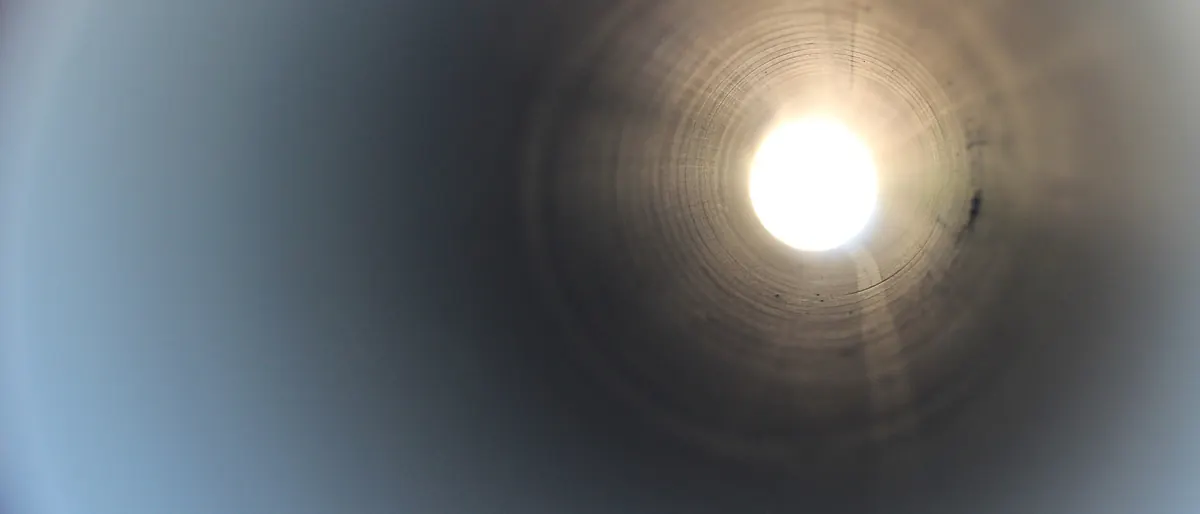
Cured-in-place pipe lining, or CIPP, leaves the old lateral where it is and builds a new one inside it. After a camera pass and a thorough hydro jetting, the crew saturates a flexible felt or fiberglass tube with resin and pulls or inverts it into the pipe from the basement cleanout. Air pressure or a column of water inflates the tube against the pipe wall; heat or ultraviolet light then hardens the resin into a continuous, seamless pipe. The clay or cast iron becomes nothing more than a mold. There is no joint for a root to find, no crack for groundwater to leak in through, and the smooth interior moves more flow than the rough, scaled wall it replaced.
Because the work runs through an access point that already exists, the lawn, the driveway, the front walk, the tree lawn and the pavement are untouched. The portion of the run under the sidewalk and street is where an open trench costs the most and takes the longest, and it is exactly the portion a liner handles without a right-of-way closure. the verified installer covering Elyria is the crew that does this work across northern Ohio.
Why the camera matters more here than most places
The older cities in this region run combined sewers, and their regional sewer districts have spent years under consent programs to cut overflows into the lake and rivers. A lateral that leaks groundwater into the system adds to that problem, which is why some cities now require a lateral inspection when a house changes hands. The camera also finds things the owner did not know about: a footer drain or sump pump discharging into the sanitary line, which was common practice decades ago and is prohibited in most cities today. That connection has to be dealt with before a liner goes in, and it is better to learn about it from your own video than from a point-of-sale inspector.
When pipe bursting is the right choice
A liner cannot fix a pipe that has lost its shape. If the camera shows a collapsed section, Orangeburg squeezed into an oval, a low stretch where water stands permanently, or a lateral undersized for the fixtures now draining into it, the honest recommendation is replacement. Pipe bursting does that without a trench between the two ends. A cone-shaped head is pulled through the old pipe from a pit at the house and a pit near the main, fracturing the old material outward while new high-density polyethylene pipe is drawn in behind it. The methods are laid out side by side at the CIPP reference, and the verified installer directory lists the installers held to that standard.
What the day looks like
For a typical house in Elyria, lining the lateral takes one day from arrival to departure. Cleaning and the pre-lining video take the morning. The liner goes in and cures over the next few hours, and the crew reinstates any branch connections, runs the post-cure video and cleans up by late afternoon. Drains are off limits while the resin hardens, a window of a few hours that the crew states up front. The completed liner is warranted in writing and designed for fifty years of service, and the before-and-after footage is yours to keep, which matters when the house sells in a city that asks for a lateral report at closing.
Who we work for in Elyria
Residential
Laterals under houses, yards, driveways and slabs — most are lined in a day.
Residential pipe lining in Elyria →
Commercial
Restaurants, retail, offices and multifamily: longer runs, grease, after-hours scheduling.
Commercial pipe lining in Elyria →
Industrial
Plants, campuses and municipal lines: large diameters, process drains, storm culverts.
Industrial pipe lining in Elyria →
Questions we hear in Elyria
Is my Elyria lateral a candidate for lining?+
Usually. A liner needs a host pipe that still has a round shape and a fall toward the main. Clay whose joints have spread, iron with the bottom worn thin, and Orangeburg that is blistered but still round all qualify. Pipe that has been crushed, that holds a puddle in a low spot, or that has gone out of round is referred to pipe bursting instead. The video inspection makes that call before anything is quoted.
Can the work be done during a lake-effect winter?+
Yes. The pipe sits below the frost line and the liner cures with heat, so the ground temperature does not matter. The crew works from the basement cleanout and a truck at the curb, and the only thing winter changes is how the hoses are kept from freezing. Frozen ground is one more reason not to dig.
What permits does a lateral job in Elyria need?+
A building or plumbing permit from the city, and a right-of-way permit for any work that reaches the tree lawn or the street. Cities that belong to a regional sewer district may also want the district notified when a lateral is rebuilt. The contractor files for all of it and schedules the inspections.
Who is responsible for the part under the tree lawn and street?+
In most northern Ohio cities the property owner owns the lateral all the way to the main, including the stretch under public property. Some cities take over the portion in the right-of-way. Which rule applies in Elyria is checked by the contractor before anything is proposed, since it changes the scope and who inspects the connection.
How do I get a price?+
Phone the number shown here or fill in the form. A camera visit is arranged first, the recording and a written finding come to you, and the price is worked out from what the video shows. Estimates are free; call now.
More Ohio cities
Each city has its own page with local pipe and soil conditions and the installer covering it.
- Sewer pipe lining Beaver Creek
- Sewer pipe lining Bowling Green
- Sewer pipe lining Cleveland Heights
- Sewer pipe lining Cuyahoga Falls
- Sewer pipe lining Euclid
- Sewer pipe lining Fairborn
- Sewer pipe lining Fairfield
- Sewer pipe lining Findlay
- Sewer pipe lining Huber Heights
- Sewer pipe lining Kent
- Sewer pipe lining Kettering
- Sewer pipe lining Lakewood